Showing posts with label Supreme Court of Texas. Show all posts

Wednesday, February 5, 2020

Texas AG Office OPPOSES Due Process and Constitutional Right to Attorney in SCOTX Case

Texas Attorney General Ken Paxton does a great job of filing briefs and taking legal action in support of constitutional rights, and many on his staff are very good at defending the Constitution. Unfortunately, at least one attorney on his staff didn’t get the memo about supporting and defending the Constitution. In Supreme Court of Texas case 19-1101, Ken Paxton’s office is arguing AGAINST due process and AGAINST the constitutional right to an attorney in criminal proceedings. These are basic constitutional rights. These are rights that Republicans shouted from the rooftops that President Donald Trump was denied these rights in the impeachment proceedings against him in the US House of Representatives. They shouted from the rooftops that these are basic constitutional rights of any criminal proceeding. But yet when it comes to an actual criminal case in Texas with someone lower in status than the President, all of the sudden these basic rights don’t matter anymore? That is wrong. Ken Paxton should be alerted to this horrendous position that his staff has presented to the SCOTX. Ken Paxton likely does not even know about this situation with all the cases his office processes, but the Ken Paxton I have seen on Fox News defending the Constitution would not agree with his staff’s position to oppose the constitution. If Ken Paxton doesn’t reverse this position by his office, then it will be a black eye for his record of defending and protecting constitutional rights in Texas. This case, if it does not end in the Texas Supreme Court, has the potential to go all the way to the Supreme Court of the United States of America. Texas is better than this. Texas should stand up for basic constitutional rights, especially in criminal cases where someone’s life is on the line and they deserve to have an attorney and due process.
The Texas Supreme Court case number is 19-1101 IN RE JOSHUA LEROY JAROS. I wrote an article about this case and the #FreeJoshJaros situation not long ago when the petition first made its way to the Supreme Court of Texas. Now the Texas Attorney General’s office has filed their response, which to my surprise the staff attorney stuck to the story of rejecting the Constitutional right to an attorney and Due Process. This is something I do not believe Ken Paxton would agree with and I hope that he hears about this and takes action to ensure his office is upholding the Constitution and Due Process.
After the response from the Texas AG’s office, a response was made on behalf of #freeJoshJaros and a portion of this response to the state is below:
Comes now Joshua Jaros and would request that this Honorable Supreme Court order the temporary release of Joshua Jaros, as requested in the original Habeas Corpus petition to this Court, pending the final decision and judgement from this Court in this case. Now that the state has responded, it is clear that constitutional violations against Joshua Jaros have occurred which deprived him of Due Process. The state failed to even address the most serious constitutional issues in their response, and agreed or didn’t dispute many key facts and issues. For instance, it is agreed upon and undisputed by all parties that Joshua Jaros faced a criminal proceeding, he requested to be appointed an attorney because he cannot afford one, there was a previous undisputed affidavit of inability to pay by Joshua Jaros in the underlying case which Joshua pointed out, the court instead gave Joshua a form to fill out that did not allow for a listing of expenses, the request for indigency was never disputed by the state before the Judge determined Joshua is not indigent, the Judge never asked for more information nor allowed Joshua to provide any information to explain his expenses and his inability to afford an attorney other than the insufficient form he was given to fill out. The court found Joshua non indigent and denied him an attorney and immediately proceeded with the criminal trial against Joshua Jaros instead of giving Joshua Jaros adequate time to find an attorney now that the Judge had just denied Joshua a court appointed attorney.
None of the above facts are disputed by any party. The dispute is whether or not the Texas and US Constitution and Due Process requires that Joshua Jaros, who was facing a criminal trial with a state attorney against him, have an adequate review of his actual ability to afford an attorney which would include a review of his necessary expenses in order to be able to make a reasonable determination of ability to afford an attorney before being denied a court appointed attorney, and then given time to find an attorney after being denied a court appointed one. The State’s position is that yes Joshua was denied a review of his expenses and denied a review of his full situation regarding ability to afford an attorney, but its ok because he doesn’t need a full review because the law doesn’t require it. The State is wrong. The law does require it as the law does require an indigency determination and an indigency determination cannot reasonably be determined without having looked at both income and expenses. However, it is true that the law, although reasonably implied, does not specifically state the process or basic guidelines of determining indigency in this case must include reviewing expenses. The state relies on the idea that the law doesn’t say it must be done so it is ok if it isn’t done. What the state fails to consider or respond to is that the Constitution is above the law. The Constitution and Due Process require that Joshua Jaros have a full and reasonable examination of his actual ability to afford an attorney, which would include reviewing expenses, before being denied the fundamental constitutional right to a court appointed attorney, or given time to find an attorney if a reasonable and adequate determination has been made denying him an appointed attorney.
The Constitution and Due Process requires this, Joshua Jaros was denied this, and therefore Joshua Jaros must be released as his rights were clearly violated. If the state’s argument is right that the law allows it, then the law must be struck down as unconstitutional because it is at odds with the constitution and due process. This is not just about Joshua Jaros. This case is about every Texan who might face a criminal prosecution and who cannot afford an attorney. There must be a more constitutional standard for which Judges must go by when determining who gets a court appointed attorney. It is unconstitutional for every judge to have a different standard, or no standard at all, which allows for them to just check a box of non-indigent and deny constitutional rights to attorneys without having been required to do a reasonable and thorough examination of the defendant’s expenses and actual ability to afford an attorney.

Friday, January 24, 2020

Texas Supreme Court Rejects Pro-Life Case – Motion to Reconsider Filed

Texas Supreme Court Rejects Pro-Life Case – Motion to Reconsider Filed


The Supreme Court of Texas declined to take up case 19-0325, but there is a pending motion to reconsider. The Supreme Court of Texas is filled with great people who I am certain would care about the issues involved in this case, but more likely than not, the Supreme Court of Texas simply didn’t directly get told in the filings that the issue at hand involved life and access to justice as the technical legal arguments do not outright say this, and the Court gets a lot of cases and cannot take up them all. That is why a motion to reconsider the case has been filed with the SCOTX and the motion to reconsider specifically points out the importance of this case and for unborn baby life and pregnant women and access to justice.
This case has some pretty strong implications about the rights of unborn baby life and medical expenses and access to justice. Effectively, the lower court and 9th Court of Appeals has determined that unborn baby and pregnant mother medical expenses are not necessary and must be paid after court costs in a case. This ruling was a huge strike against women and babies and access to justice in general. The SCOTX not taking up the case effectively approves of and allows to stay in place the lower rulings which have wide-reaching implications.
The text of the Motion to Reconsider is here below:
MOTION TO RECONSIDER PETITION FOR REVIEW
Unborn Baby Expenses should NOT come after court costs and this Supreme Court should NOT vote AGAINST life. Access to Justice is DENIED if lower courts can simply refuse to consider expenses before determining ability to afford court costs.
Comes now Appellant and request this Honorable Supreme Court of Texas to reconsider appellant’s Petition for Review.
I request this court to reconsider their decision not to take up a petition for review of the above referenced cause. On the face of the appeal, the issues might not seem important enough for this Supreme Court to take up, even with apparent flaws or issues of the underling orders. I understand there are a lot of cases and the SCOTX can only take up a small percentage of them, however, I would like to express to this court that the underlying issues are much more important than they appear at first glance.
First, A denial of the Supreme Court’s review of this case will be a major anti-life statement. The 9th Court of Appeals decided that medical expenses of an unborn baby and pregnant mother are NOT valid expenses that should be paid before having to pay court costs of an appeal. Specifically, I had filed motion of material change in financial circumstances in regards to paying the large amount of court costs of an appeal. The change in circumstance was due to my wife becoming pregnant and there being new and vital medical expenses for the life of my unborn son and the health of my pregnant wife. The 9th Court of Appeals denied this motion and then dismissed the appeal stating that there had been NO reasonable reason for not being able to pay court costs. The 9th Court of Appeals effectively and literally determined that the life and health of an unborn baby and pregnant mother are NOT worth of consideration, and NOT reasonable or necessary to pay before having to pay appeals court costs. Appeals court costs must come first before medical expenses for the life and health of a baby is the statement and decision made by the 9th Court of Appeals. If this Supreme Court of Texas refuses to take up this petition for review, then this court is effectively agreeing with and upholding the radically wrong anti-life decision by the 9th Court of Appeals. Clearly the issues of this case are not simply about a small court costs disagreement, but rather it is about a much bigger and more important issues which will send an anti-life message across Texas if not reviewed by this Honorable Supreme Court.
Second, a denial of the Supreme Court’s review of this case will be a major blow to Access to Justice (which this Court has pushed hard recently to reform to allow access), and it would send a statement to Texas that Supreme Court guidelines for determining ability to afford costs are irrelevant and allow for lower court to use different and contradictory and vague and unconstitutional guidelines to determine inability to pay for access to courts and therefore violates due process. Specifically, in this instant case, the lower court did not follow the set guidelines and rules regarding affidavits of inability to afford costs. The biggest flaw is that the lower court did not even consider any personal or business expenses or obligations before determining ability to afford costs. This completely contradicts the Texas Supreme Court having rewritten indigency rules to require examination of ability to afford, not just ability to pay. Income of any amount cannot alone be examined before determining ability to afford costs without having first having examined expenses to or other obligations to determine what portion of income is even available to use after necessary expenses to live. In this instant case, the lower court NEVER examined ANY expenses or obligations and therefore could never have determined my ability to afford costs at that time. The lower court did not even examine my personal bank account or current personal income. The lower court only examined the money of a small business corporation that I had an ownership interest in. The court saw a few thousand dollars in the company account at the end of each month and said hey I should just raid the company account and get that money to pay my personal court costs because I am able to access the company bank account. Had the trial court actually followed indigency and ability to afford guidelines, the trial court would have seen that any payments I had gotten from the company were a year before the indigency hearing and and had not been received in nearly a year and the company had no positive value to me and was a young company owned by financing and another business who financed the start of the company and therefore was not even a positive asset to add as current income or asset positive value on an ability to afford cost form. Me simply being able to access the company bank account does not mean that the company money is mine to take even if I had gotten payments previously when the company had the ability to pay. The other owner of the company actually has a court order from a different court which PROHIBITS me from taking company money, which he has a majority interest in and which are for paying company expenses, and using it for my personal court costs. I would actually be violating a court order if I did take company money for personal expenses. But even if the court did determine I could just raid the company account, The court was required to, but never examined any expenses or obligations because if it had it would have found that the little money left over in the business account was to pay for the next week payroll of the employees of the small business or the taxes every three months or the debt payment to the companies and financial institutions that effectively owned the company through financing agreements. The lower court and opposing attorney Scott Browne and 9th Court of Appeals would have me commit fraud or other serious crimes or unethical behavior by taking company money that belonged to employee pay or belonged to the customer who gave that money to the business to but them a new heater. Surely this honorable Supreme Court would not agree with me resorting to stealing from employee paychecks or committing fraud by taking money from the company account that is there to pay for a customer parts? And that is the massive issue with this case. The issue is that the lower court and even the appeals court have simply ignored the SCOTX guidelines for determining ability to afford costs. This lower court and the 9th Court of Appeals determination to ignore necessary expenses violates due process and the Constitution because true ability to afford costs to access the courts cannot be determined without having examined both income AND expenses. What is the point of this SCOTX creating ruled for examining ability to afford costs to allow for access to justice if the lower courts and the appeals court can simply ignore these guidelines and declare someone able to pay costs without having ever determined expenses and ability to actually use income. This is an issue that is widespread and greatly impacts other Texans and deprives many other people of the ability to access courts if there are no enforceable standards of determining indigency and examining expenses before making a determination about ability to afford costs. In fact, this Supreme Court of Texas has a different case, a habeas corpus case, before it right now involving a young father Joshua Jaros who was jailed without having a right to be represented by an attorney. That case before the SCOTX is cause 19-1101 and this court has yet to rule on that case. In that case, Joshua declared his inability to afford an attorney and the trial court denied him a court appointed attorney without having considered his expenses and ability to afford an attorney. The 9th Court of Appeals was again the appeals court in this case and the 9th Court of appeals declared that expenses and actual ability to afford costs don’t ever have to be considered. Interestingly though, the 9th Court of appeals, in their upholding that the trial court did not need to examine expenses for determining indigency for a court ordered attorney, specifically acknowledged caselaw regarding the need to examine expenses for ability to pay court costs. The 9th court of appeals has contradicted themselves by denying the need to examine expenses in my inability to afford court costs, while acknowledging in Joshua’s case that expenses do need to be considered for court costs and ability to afford them. Clearly there is a pattern of different people being denied due process and being denied constitutional rights due to Texas trial courts and specifically the 9th Court of appeals determining and upholding this flawed notion that it is ok to determine that someone can pay for court costs or for an attorney and can be denied these rights to access justice and rights to a court appointed attorney by simply declaring they can pay without ever having actually examined their ability to afford and without ever having considered expenses and obligations. The SCOTX must take up this issue and provide clarification and enforcement of guidelines for determining ability to afford and access to justice, instead of the lower courts and the appeals court having different and even contradictory guidelines to determine ability to afford which allows for ignoring expenses and violated due process.
Prayer
I pray that this honorable Supreme Court of Texas reconsider their denial to take up my petition for review of the above referenced case. I pray this court takes up my petition for review due to the important and far reaching issues and implications of the underlying case regarding life and access to justice and guidelines for inability to afford determinations

Sunday, January 19, 2020

Texas Supreme Court to Rule on #FreeJoshJaros - Constitutional Rights to Attorney at Stake

I recently helped file a Petition for Writ of Habeas Corpus before the Supreme Court of Texas regarding the egregious constitutional violations of Judge Patrice McDonald in Montgomery County, Texas. Hopefully the SCOTX will stand up for the Constitution and Free Joshua Jaros. Specifically, Judge McDonald refused to allow Joshua Jaros to have an attorney in a criminal proceeding, and then threw him in jail for a debt that he could not afford and without the chance to have an attorney to represent him and present his case as the Constitution requires.

The Joshua Jaros Habeas Corpus petition Supreme Court case number is 19-1101 IN RE JOSHUA LEROY JAROS. 

If the name Judge Patrice McDonald sounds familiar, it is because she has been in the headlines recently by Investigative Reporter Wayne Dolcefino. Wayne has been exposing Judge McDonald after she threatened to throw a man in jail for not paying for an attorney and for spousal support for his bigamist ex in a divorce proceeding.

The man, Mark Athans, filed for divorce after he found out his wife of 5 months was already married. The woman was a fraudster and charged with Felony Bigamy. The marriage between Mark and woman was voided in the state in which it occurred. That didn’t stop Judge McDonald though who proceeded with the divorce case and refused to consider that there is no marriage due to the fraud and felony behavior of Mark’s ex, and even was going to jail the victim Mark if he did not pay his con artist ex’s attorney fees.

The latest victim of Judge McDonald is Joshua Jaros, who now sits in jail after having his Constitutional rights tossed out the window. The situation with Josh Jaros reveals a bigger issue with the horrible family law system in Texas in which good parents, mostly fathers, get separated from their children which causes a ripple effect of harm to the children and society as a whole. Reducing incentive for parents to fight over children should be a priority in Texas. Equal Shared Parenting laws overwhelmingly and on a bi partisan basis passed out of the Texas House this past session but never made it to the floor. Children should be able to have access and love from both fit parents, and parents should not have incentive to fight with their children’s lives and instead have to practice equal shared parenting. This would reduce the factual devastating effects on children that this fighting and parental alienation causes because parents will be forced to share costs and parenting instead of parents using their children as pawns to get a little more parenting time to hurt their ex or to be able to get more child support or be awarded legal fees for their lawyers.

Josh Jaros was jailed in Montgomery County Texas after he received no jury trial and after he was denied an attorney which is a basic constitutional right and is even Texas Law. There were other issues as well such as fatal flaws in the notice and pleadings. Josh Jaros is a great father who supports and takes care of his kids but could not pay the several hundred dollars a month to his ex-wife each month after Josh already pays to take care of his kids half the time and provides a roof over their head and food for them to eat etc. Both parents should always be able to equally be with their children if there is no threat of harm or violence etc, and supporting children in Texas means both parents taking care of the children equally. Texas needs to pass equal shared parenting laws so that children get to have both of their parents in their lives, and it would exponentially cut down on the fighting and tearing apart and bankrupting of families in the court system of fit parent had no choice but to share their child equally instead of being able to go to court and fight for more time or more money. #FreeJoshJaros

The Texas and US Constitutions require that any criminal defendant has a right to an attorney and even the right to have one appointed for them if they are unable to afford one. Seems pretty straight forward right? Unfortunately, the Court systems in Texas (and in the Nation) do not always follow the Constitution and are in need of serious reform. The Constitutional rights we all hold dear frequently get tossed out the window in courtrooms where judges can virtually do whatever they want with immunity. There are many good and great Judges who follow the law and the Constitution, but there are also Judges who do not. There is very little oversight when clear laws and rules are violated by judges. There is even less method of reprimanding a Judge, and even less of an adequate way to reverse a Judge who clearly violates the law or the Constitution. If the Law or the Constitution says a Judge has to do something specific, and the judge simply refuses, then what recourse does someone have? Just because the law says it MUST be done does not mean a judge has to follow it because there is NO reason for them to. They won’t be disciplined. They MIGHT be overturned if you can get an appeals court to take interest in the case but that could take years on appeal. Mandamus is the appropriate form of demanding that a Judge follow the law or constitution when it is clear they have not during the pendency of a case, but mandamus is rarely taken up even if the judge is completely wrong because the appeals court does not have to take them up and can just say they don’t have time to rule on the mandamus. Texas must create a better system of immediate and mandatory review when there is a question of whether or not a judge in a case is not following a clear and mandatory law or rule that must be followed. People’s lives and time and money should not have to wait for years of appeals to overturn a bad judge when there is a clear violation of law or rule by a judge. The clear violation by a judge should be resolved quickly so the underlying case moves forward and gets resolved in a fair and unbiased manner. Judges should be more strictly required to follow mandatory laws and procedures or face real consequences. As it stands now, Judges have no incentive to actually follow mandatory requirements if they know they will not get in trouble.

Monday, December 9, 2019

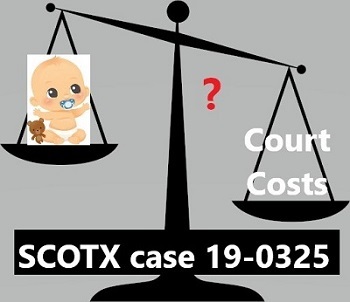
Texas Supreme Court to Decide if an Unborn Baby Should get Medical Care Before Paying Court Costs, and if a New Pregnancy is a Change in Circumstances re: Access to Justice

Texas Supreme Court to Decide if an Unborn Baby Should get Medical Care Before Paying Court Costs, and if a New Pregnancy is a Change in Circumstances re: Access to Justice


The Supreme Court of Texas has a case before them right now, Case 19-0325, which if they deny the petition, the Texas Supreme Court will have effectively agreed or let stand a ruling by the Texas Ninth Court of Appeals that a pregnancy is NOT a change in financial circumstances. Even worse, if the Texas Supreme Court denies this case, then it will be agreeing or letting stand an absurd determination that the health and health expenses of an unborn baby are not important nor necessary, and that the courts should require unborn babies to be denied medical care so that court costs can first be paid in order to access the justice system and file an appeal. It would also muddy the waters regarding access to justice and standards for inability to afford costs that the SCOTX has pushed to try to clear up in recent years.

This case before the SCOTX is very important for multiple reasons. The first reason is pretty obvious. It is absolutely absurd that an appeals court in Texas has determined that a pregnancy is not a material or substantial change, and that medical expenses during a pregnancy are NOT IMPORTANT and instead the courts should get their access to justice fees paid first before the medical needs of an unborn child can be paid for or risk being denied equal access to courts and justice.

The second reason this case is important is because it involves access to Justice. The Supreme Court of Texas has spent considerable time and effort in recent years taking a stand and fighting FOR access to justice, which is a fundamental constitutional right. Particularly, the SCOTX has created rules and developed case law through rulings aimed at forcing courts to allow people the right and opportunity to access courts and access justice even if they are unable to afford court costs. This is a big shift, as previously the standard was ability to pay, not ability to afford. The SCOTX realized that just because someone has $10 in their account that doesn’t mean the $10 is available to spend on court costs if, for instance, food and housing needs to be paid first. Therefore, the standard shifted to ability to afford, which required courts to actually examine someone’s income AND expenses before determining if someone can actually afford court costs after necessary expenses. Unfortunately, many lower courts still haven’t come on board with the new rules regarding access to justice or they are simply openly defying the guidance from the SCOTX. This case is a prime example of complete disregard for access to justice and the standards for determining ability to afford that have been set forth by the SCOTX.

So, what exactly is this current case before the Supreme Court of Texas? Here is what happened. An appeal was made to the 9th Court of Appeals in Beaumont, TX (Jefferson County). An affidavit of inability to pay court costs was included so that the appeal could move forward even though there was an inability to afford the thousands of dollars in court costs to file an appeal of the trial court ruling. The appeals court kicked the ability to afford decision to the trial court. The trial court, without ever examining or even considering necessary expenses, determined that there is an ability to afford the thousands in court costs. This determination was challenged in the appeals court because, based on the rules and caselaw and plain common sense, there cannot be a determination regarding ability to afford without having looked at expenses and making factual determinations regarding both income and expenses. Additionally, since the appeal was filed there was a new pregnancy with new unborn baby medical expenses that must be considered and paid first before court costs. The Ninth Court of Appeals then ruled that the trial court did not need to examine expenses or that the appeals court didn’t care if the trial court didn’t examine expenses before making a determination on ability to afford court costs. Additionally, the Ninth Court of Appeals rejected a motion regarding a change in financial circumstances due to a new pregnancy and went on to specifically state in their final order to pay court costs that there had not been any material change in circumstances presented that warranted review, which effectively declared a new pregnancy as not an important change to consider. Even worse, it deems unborn child medical expenses as not worth examining and the unborn child expenses should come second to paying court costs. The Ninth Court of Appeals then went on to dismiss the proceeding without ever reviewing the merits of the case due to the thousands of dollars in access to justice court fees not having been paid despite the courts never having actually reviewed ability to pay, and after having determined that court fees come first before necessary unborn baby health expenses.


So that is what leads us to this current case before the Supreme Court of Texas. This is a very important case that everyone should keep an eye on. If the Supreme Court of Texas does not take up this case, then the SCOTX will be effectively agreeing and allowing to stand the lower court and appeals court’s absurd and vague determinations regarding everything from pregnancy necessary expenses to access to justice rights. A denial of this petition for review would be completely contrary to the recent SCOTX push for access to justice, and would set the cause back by allowing lower courts to deny access to justice in spite of the SCOTX rules and constitutional rights. The Supreme Court of Texas has done a fabulous job of pushing for access to justice and we can only hope that the SCOTX will continue to push for access to justice by taking up this case to review the serious issues that undercut the SCOTX’s own rules and guidance on the issue.